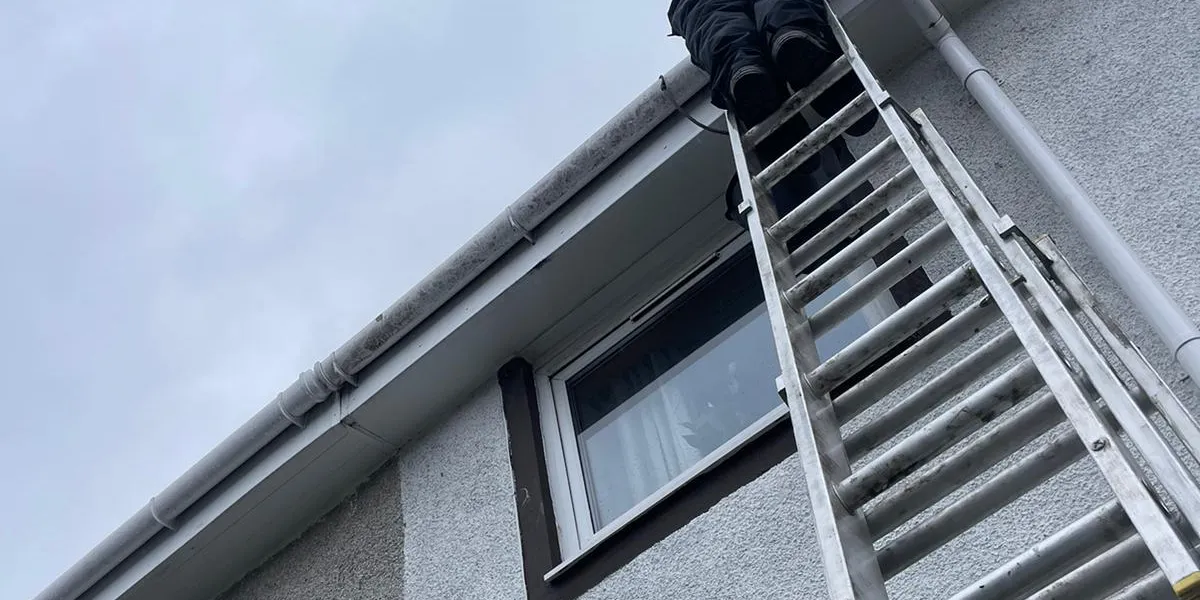
You’re standing in your garden, looking up at your gutters, and thinking about clearing them. The question is, what size ladder for gutter cleaning do you actually need?
I’ve got good news and bad news for you: there’s no single ladder size that fits every house.
The right size depends mostly on how high your gutters are. A safe ladder is long enough that you shouldn’t be working from the top three rungs, it extends at least 1 metre above where you’re working, and you’ve set it at the correct angle.
Don’t get me wrong, a ladder is great if you’re just clearing a small blockage on a bungalow.
But for anything else, you need to get the setup right.
The 1-in-4 rule for ladder safety
The Health and Safety Executive (HSE) guidance says a leaning ladder should be at a 75° angle.
The easy way to check this is the 1-in-4 rule: for every four units you go up, the feet of the ladder should be one unit out from the wall.
Here’s what that looks like in practice:
| Height where the ladder rests against the wall | Distance of ladder feet from the wall |
|---|---|
| 3 metres | 0.75 metres |
| 4 metres | 1 metre |
| 6 metres | 1.5 metres |
| 8 metres | 2 metres |
This isn’t a chart of what length ladder to buy. It’s how to position the one you have.
How to measure for the right ladder size
You have to measure to know what size you need. Here’s how I’d approach it.
Measure the vertical height from the ground to your guttering. Let’s say for example it’s 4 metres.
You’ll need a ladder that is longer than 4 metres. There are two key safety points to remember:
- The top must extend at least 1 metre (about three rungs) above where you’re working.
- You must never work from the top three rungs.
So for a 4-metre-high gutter, you need a ladder long enough that you can reach it without standing on the top three rungs, with its top at least 1 metre above where you’re working.
You also have to account for the angle. A 6-metre ladder might sound like plenty, but once you set it at the 1-in-4 angle, its actual reach is less.
Then, check your setup. The ladder needs a strong upper resting point; I’d never rest one against plastic gutters, as the weight can damage them.
You should use a stand-off device, which gives the ladder a strong place to rest.
And the feet must be on firm, level ground that’s clear of moss, wet leaves, or loose material. (Well, presuming the ground is firm and level to begin with).
5 factors that make a ladder unsafe
Getting the size and angle right is only the start. A few other things can make a ladder the wrong tool for the job.
- Wind: Here in Eastern Scotland, we get some serious wind, especially from December to February. Ladder makers say the same: don’t use one in strong wind.
- Ground conditions: That patch of moss or pile of autumn leaves on your pavement can make a ladder foot slip. The ground must be clean and solid.
- Overhead power lines: You must not work within 6 metres horizontally of an overhead power line unless it’s been made dead or is insulated.
- The public: If your gutters are over a public pavement, like on many of the tall granite townhouses in Aberdeen, you have to manage the risk to people walking below.
- Time: As a guide, if you’re going to be up a leaning ladder for more than 30 minutes at a time, you should be using other equipment.
For taller buildings or jobs where a ladder isn’t the safest choice, we work from the ground. If you have a three or four-storey property, give Sam’s Gutter Cleaning a call and we can explain our ground-based pole and camera system.
Why professionals do a risk assessment first
For us in the trade, the first step is a risk assessment, because the regulations that apply to us put things in a clear order: try to avoid working at height completely.
If you can’t, use equipment to prevent a fall. A ladder shouldn’t be your first choice.
That’s why three and four-storey buildings are done from the ground instead.
We use a powerful vacuum on lightweight poles with a camera at the top. This lets us see inside the gutter and clear it completely from the safety of the ground.
For properties with public access below, we work in a two-person team. One person operates the equipment, and the other acts as a spotter to keep the public safe.
It avoids unsafe ladder use, and the weight of a ladder on your guttering or fascias.
If you’d rather leave the ladders and the muck to someone else, get in touch. We can give you a clear quote for the work and get your gutters flowing properly again. There’s more on our gutter cleaning service here.
Ready to Get Your Gutters Cleaned?
Book your free quote today and keep your home protected from water damage.
Get Free Estimate